Subscriber question:
“I think conventional analog gauges are easier to fly than glass. With needles, I can tell at a glance if I’m on target. What am I missing?” — Plover K.
Not subscribed yet? Sign up here to receive tips like this every week.
Ryan:
 “The instrument scan should be easier with modern glass displays, but for many experienced steam gauge pilots, it’s not.
Consider the altimeter. In level flight, the hundreds needle is usually either straight up or straight down because the altitude you’re holding is either a thousand-foot increment or a thousand plus 500. It’s simple to detect a deviation from needle straight up or needle straight down, even without looking directly at the altimeter. Not so on glass displays, where it seems necessary to look at the altitude tape and process a number.
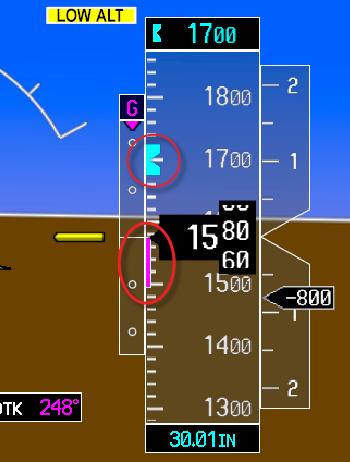
The solution is using bugs. Set the altitude bug to your target altitude and you’ll see at a glance the relationship between the bug and the altitude pointer. There’s no need to read a number with each scan. That works equally well for any altitude, and for headings and airspeeds too. In many setups, you’ll even get an aural warning when approaching or departing bugged altitudes.
Trend indicators are another helpful feature of glass panels. These are typically magenta lines extending out from the pointers on each performance instrument, that show where you’ll be six seconds in the future if nothing changes. The magenta color stands out even if you’re not looking directly at it. If you’re attempting to maintain altitude, the trend indicator may be your first sign of a deviation, before the altitude itself changes noticeably.
The instrument scan is a crucial IFR skill. For VFR pilots, the more efficient the time spent inside the cockpit is, the more attention can be spent where it belongs: out the window. Practice setting bugs to target values and watching for trend indications, and you’ll soon find that you never want to go back to steam gauges.”
Watch this video for more tips about glass cockpits from PilotWorkshops IFR: The Missing Lessons.
Do you think experience flying conventional round gauges is important for new pilots who might start learning behind a glass panel?