Subscriber question:
"I'm uncomfortable slipping on final because I’ve heard so much about the deadly base-to-final spin. How do I get over this fear ... or am I right to be afraid?"
Not subscribed yet? Sign up here to receive tips like this every week.
Spencer:
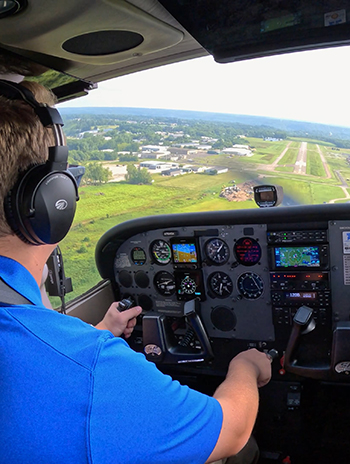 “Every pilot should be comfortable executing a slip on final. It’s helpful in losing altitude if high on final and critical for a smooth, centerline landing with a crosswind.
The yaw in one direction and bank in the other can feel awkward at first. Add the back pressure often required to control airspeed with pitch, and it may feel like the aircraft is on the edge of a stall. But when slipping on final, the nose will appear well below the horizon and the wing is far from exceeding its critical angle of attack. The best way to get comfortable with slipping is to learn what it looks like when the plane stalls during the slip. That means practicing a cross-controlled stall at a safe altitude in your airplane.
Some pilots believe that applying rudder during a stall will automatically cause a spin. That’s not always the case. A cross-controlled stall shouldn’t be confused with stalling during a skid. When skidding, yaw and bank are in the same direction. This is the scenario that can kill when it turns into a low-altitude spin. In a cross-controlled stall, the yaw and the bank oppose each other, effectively canceling out the forces that typically lead to a spin. As a result, the airplane remains stable and won’t enter a spin.
To perform the a cross-control stall:
- Climb to a safe altitude.
- Configure the airplane for landing.
- Reduce power to idle and stabilize at final approach speed with the nose visually below the horizon.
- Begin the slip by feeding in full rudder in one direction and apply just enough opposite aileron to maintain a straight ground track. Use a road or other ground reference as your simulated runway.
- While holding the slip, slowly pull back on the yoke or stick to increase pitch until you reach the initial stall buffet.
- When you feel the buffet, lower the nose slightly to recover; maintain the slip throughout.
What you’ll notice may be surprising. The nose climbs significantly above the horizon before the stall occurs—higher than you’d expect—and the airplane remains docile and controllable throughout. It won’t spin because the opposing yaw and bank forces are in balance.
If you’ve never done this before, fly with an instructor who has, ideally one with solid spin training and an understanding of cross-controlled stall dynamics.
Also, a note on aircraft limitations. Some airplanes – like certain Cessnas with 40° of flaps-are placarded to avoid slips with full flaps. In all but the earliest models, this is only a caution, rather than a prohibition, due to possible tail blanketing and oscillations.
This demonstration will greatly enhance your confidence and precision when slipping to land, which is a powerful technique in your pilot toolkit.”
Check out the video version of this tip to see what stalling in a slip looks like.
Have you ever stalled in a slip?