
Subscriber question:
"At some airports, there are similar instrument approaches to the same runway labeled Y and Z. What is the difference?" - Glenn B.
Not subscribed yet? Sign up here to receive tips like this every week.
John:
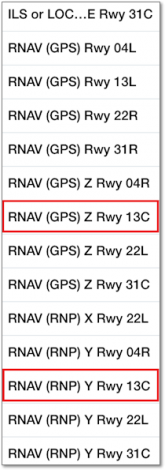 “When two or more straight-in approaches with the same type of guidance exist for a runway, the FAA adds a letter suffix to the title of the approach for identification purposes. These approach charts start with the letter Z and continue in reverse alphabetical order. Because only one of each type of approach for a runway, i.e. ILS or GPS can be coded into a database, a method to distinguish between the two approaches was developed.
For example, consider the RNAV (GPS) Z RWY 13C and RNAV (RNP) Y RWY 13C approaches at Chicago Midway. Although these two approaches may be flown with GPS to the same runway, they are significantly different. One requires different aircraft equipment and pilot certification; one has circling minimums and the other does not; the minimums are different; and the missed approaches are not the same.
The approach procedure labeled Z will have lower landing minimums than Y. In this example, the LNAV MDA for the RNAV (GPS) Z RWY 13C has the lowest minimums of either approach due to the differences in the final approach area obstruction evaluation (the two approach types have decision points at different distances from the runway so the obstacles under each decision point may be different).
The convention of adding a letter at the end of the approach name eliminates any confusion with approach procedures labeled A and B, where only circling minimums are published.”