Subscriber question:
"I don’t understand what the Ammeter is telling me." —Jamie J.
Not subscribed yet? Sign up here to receive tips like this every week.
David:
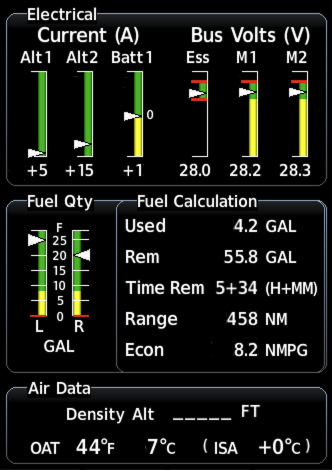 “Let’s start with Airplane Electrical 101. When you turn on the master, all power comes from the battery. After startup and with the alternator turned on, the alternator provides power to the airplane and recharges the battery, which will be at least somewhat depleted from engine start.
Most ammeters show how much current is flowing to or from the battery. A minus value indicates the battery is discharging, or losing energy; a positive value means it is gaining energy by being charged by the alternator. The center zero position on the ammeter indicates a neutral state, the battery is neither gaining nor losing energy. It’s normal right after engine start to see a high positive indication, perhaps half the scale shown. The starter draws a lot of power from the battery. But the needle should drop towards zero within a few minutes. As you taxi out, the needle may be slightly negative as the alternator output is low at taxi RPM and can’t provide quite enough power for all the systems, like avionics and lights. That’s normal. When you do the runup, you can test the electrical system by turning on pitot heat, the landing lights, and operating electric flaps, if fitted. The ammeter needle should bounce negative but immediately return to a near-zero indication. In flight, the needle should be slightly positive.
Note that there are some installations with a loadmeter, even though it’s called an ammeter. Pipers often have these. Rather than a scale from a negative charge to a positive one, with zero in the center, these start at zero and only show a positive scale. In this case, you would see zero with the master on before engine start, a high reading after start (where the alternator is providing power and recharging the battery), and then a slightly lower reading in flight once the battery is replenished.
Abnormal indications for either an ammeter or loadmeter would be a full-scale positive charge right after start. That would indicate the starter was being driven by the engine and acting like an unregulated generator. Shut down immediately if that happens. In fact, any full-scale reading, either positive or negative, indicates a dangerous amount of current is flowing into, or out of, the battery. Complete the POH emergency checklist immediate action items as soon as possible. Inaction will likely lead to major electrical system damage and possibly an electrical fire.
A high, persistent positive but not full-scale indication, after start indicates a faulty alternator voltage regulator or a failing battery. A persistent negative indication at runup or in flight is likely an indication of a failing alternator. That might be the alternator itself or the belt that drives it has broken. Another possibility is that the over-voltage relay has tripped. This protects the airplane from excessive alternator voltage by automatically disconnecting the alternator, which has the same effect as if the alternator had just failed. Many of the older single engine Cessna’s have a warning light labeled “high voltage,” which will come on if the overvoltage relay trips.
Understanding and reacting to electrical malfunctions might save you from a nuisance, like a dead battery. It could also prevent a critical in-flight emergency, like an electrical fire. Read and heed the ammeter.”
Watch this short video on how to set up your airplane for runup and see what your ammeter should be showing from our “Airplane Engine Operations” online course.
How do you most often remember routine engine gauge checks in flight?