
Subscriber question:
"I routinely use checklists on the ground, but I almost never use one in the air. Is this really a problem?" — Pat S.
Not subscribed yet? Sign up here to receive tips like this every week.
Jeff:
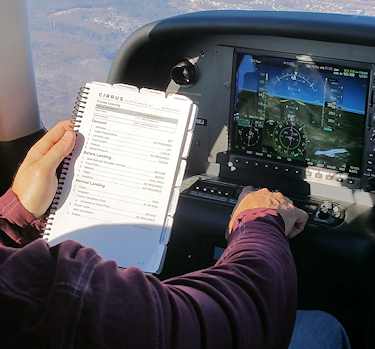 “Let’s remember why checklists exist: They help ensure all the steps for a particular phase of flight are accomplished, and accomplished in the right order if necessary.
When you’re on the ground and time is abundant, working your way through a printed list is a practical way to accomplish the task. (This can be called a do-list). You do each action as you read it off.
When you’re in the air, sometimes that’s just not practical as a single pilot. In this case, a flow check is a great tool. You’ll start at some position in the cockpit, often the fuel selector in many light airplanes. Then you’ll move your hand across each group of controls or gauges and ensure they are where they should be for that phase of flight.
For a Cessna 172 it might sound like this: Fuel on both; trim is set; circuit breakers are in; power and mixture control set; lights and other switches set; engine gauges green; flight instruments set; avionics set. Essentially, the aircraft’s switches and instruments are the checklists.
The exact path of the flow varies with each aircraft, but it covers all the main points. Then you can grab a checklist at your convenience and quickly verify that nothing was missed.
Flow checks can be used for each change in phase of flight: takeoff to cruise climb, climb to level, on descent for the airport, entering the pattern, and so on. Even if time doesn’t allow the verification by the printed checklist, your flow check likely got all the essential items for safety.”
How do you use a checklist in the air?