Subscriber question:
"Does it matter which direction I turn the prop?" — Bob R.
Not subscribed yet? Sign up here to receive tips like this every week.
Dean:
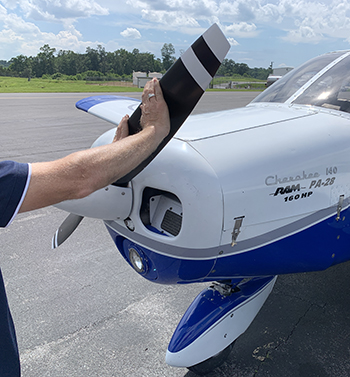 “You can turn the prop either direction, but the best way is to turn it in the reverse direction of normal rotation, for one main reason. If one or both mags have an impulse coupling for starting, you will not engage the impulse coupling in the reverse direction. And in the rare case where there is a hot mag and fuel in the engine, you will avoid having the engine fire as you rotate the prop.
If this procedure saves a life or prevents an injury once in a while, it’s well worth it. And even if your airplane does not have an impulse coupling, it’s still a good practice, because someday you might turn someone else’s prop, and it’s good to be in the habit of turning the prop backwards.
Some people say you can break a vacuum pump vane by turning the prop backwards, but I’ve never actually seen that in 25 years of maintenance. I’d much rather break a vacuum pump vane than to endanger a human life by having the engine fire unexpectedly.
Turning the prop backwards is a normal procedure during compression testing and during mag timing. It also makes sense to turn the prop backwards to put the tow bar on. Adopting this practice just might save a life one day.
Disclaimer: This does not apply to Rotax engines. It does apply to the typical direct-drive Lycomings and Continentals we see on many piston-powered airplanes.”
To see information about removing a cowling and inspecting the engine compartment, check out this sample from Airplane Engines: A Pilot-Friendly Manual.
Do you have a specific direction you turn a propeller by hand?