
Subscriber question:
"I've been told that POH airspeeds related to angle-of-attack (like stall speed) change with the weight of the airplane. I'm terrible with math. Is there a better way to fly the right speeds—or at least close enough?"
Bruce:
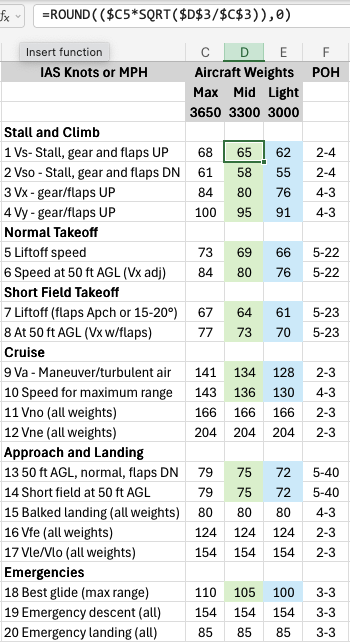 “In ground school, we learn that some aircraft speeds change with weight. Stall speed, maneuvering speed, and the best final approach speed are just a few. The correction factor is the square root of the actual weight over the gross weight.
Another rule of thumb is to decrease the maximum gross-weight speed by 5% for each 10% reduction in actual gross weight.
It’s easy to do those calculations during preflight planning, calculator in hand. But math—especially when square roots and percentages are involved—can be challenge when you’re in the pilot’s seat.
I learned a better way during my training to become an instructor for the American Bonanza Society (ABS). One of the homework assignments for the customer receiving training is preparing an airspeed worksheet. It’s a table filled in before the first lesson, using data from the POH/AFM.
Instead of formulas, the completed table presents the numbers for the aircraft at light, medium, and maximum weights. Those approximations are close enough for typical light GA aircraft in most situations, and they include useful targets for various phases of flight, from takeoff to touchdown—including key emergency airspeeds.
I added the table to the custom checklist that I created for my A36 Bonanza. The information is readily available as I brief a departure or approach and landing, and it’s also at hand when I run a checklist after completing a cockpit flow during a simulated emergency.
You can easily fill out a similar table using the guidance in the POH/AFM for your aircraft for the weights at which you typically operate. It’s a great rainy-day exercise.”
How do you adjust your final approach speed for weight?