Subscriber question:
"What’s the easiest way to pick the route for IFR flight that ATC actually wants me flying?" — Joe M.
Not subscribed yet? Sign up here to receive tips like this every week.
John:
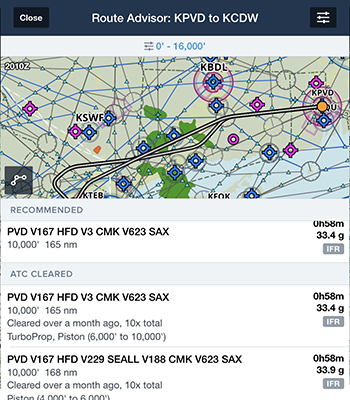 “I have found that the easiest and most user-friendly method to find out about preferred routes is to use one of the online flight planning tools such as ForeFlight or FltPlan.com.
Either of these tools will display a list of routes that ATC has assigned to aircraft between the two airports requested. Look at the routes and aircraft types carefully. It is not uncommon to find different routes and altitudes depending upon type of aircraft, such as piston, turboprop, or jet. Aircraft type and equipage may limit the terminal procedures (SIDs and STARs) that you should consider. Make sure you should (and can) fly something before you file it.
If your airport doesn’t have a route listed, check nearby larger airports. The flows in and out of these should be similar to what you’ll get. What you really care about might be how to arrive into a given area from a particular direction, rather than routes specifically from ABC to XYZ.
Consider tapping into local knowledge. A local pilot or flight school is likely to know what routes are usually approved. The FAA publishes a generic index of preferred routes between certain city pairs in the Chart Supplement (formerly the Green Book). I found these of limited value and can be cumbersome to use.
If all else fails, call the facility clearance delivery number listed in the Chart Supplement. You can speak directly to the controller who will be issuing the clearance. Ask the controller the best route to file. They have all the routes listed in their database.”
If you fly IFR, what's your most common method for selecting a route to file?