
Subscriber question:
"Why in this digital age don't we have clearances sent directly to our cockpits?" — Aiden M.
Bruce:
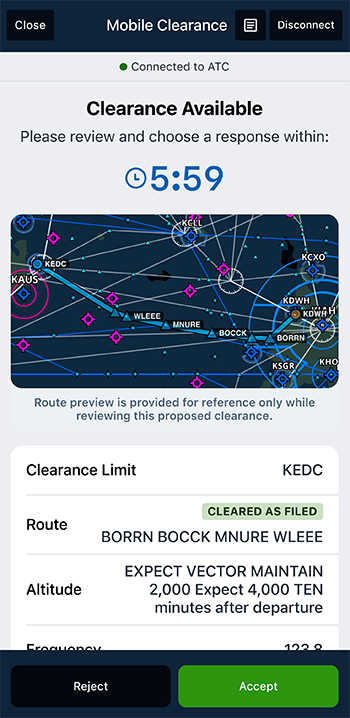 “Reading back IFR clearances is a time-consuming, error-prone, and frustrating ritual for both ATC and pilots. And with over 25,000 clearances read out and back each day, that’s a lot of time, error, and frustration.
The FAA is testing a new service to provide IFR clearances via text to mobile devices. The evaluation phase of Mobile Clearance Delivery (MCD) started with an announcement at AirVenture in July 2026, and the service is now available at KATW in Wisconsin; KMKC and KIXD in Kansas; and KCLL, KDWH, KSGR, and KGLS near Houston. More airports will be added, but the FAA has not published a schedule.
MCD works like this:
- You file an IFR flight plan with Foreflight or Garmin Pilot (other service providers will be added as the program is expanded).
- When your clearance is available, typically 30 minutes prior to your filed departure time, the app displays a “request clearance” message. Tap to proceed.
- The controller finds your clearance in a list of proposed IFR flights on a computer connected to the MCD system.
- If nothing needs to change, the controller presses a button to send the clearance to your EFB. The controller can also add details, such as amended route or altitude, if necessary, before sending the message to you.
- The message—always a full-route clearance including any necessary remarks such as “expect vectors” — appears in your EFB. The sequence follows the CRAFT template and includes all the details, such as a departure control frequency and transponder code, that you get when ATC reads a clearance.
- If your EFB is connected to your panel, beam the route to your navigator.
- If you reject the mobile clearance because you have question or want ATC to change the clearance, contact a controller as usual to resolve the issue.
Initially, MCD will be available only at towered airports, but the FAA plans to provide the equipment to TRACONs and centers that control airspace at non-towered airports. The process will be the same, but your clearance will include a “hold for release” instruction. You will still need to contact ATC via radio or telephone to get a verbal release before you take off. Do not depart VFR, squawking the code assigned in your clearance, without a release. The FAA plans for MCD eventually to support issuing IFR releases and to allow pilots to cancel IFR after landing.”
- To learn more about MCD, see the AOPA Webinar with a presentation from the FAA team that created MCD.
- For updates on airports where MCD is available and other details, visit the FAA Mobile Clearance website.
- ForeFlight users can learn how MCD works in ForeFlight.
- Garmin Pilot users can learn how MCD is supported in Garmin Pilot.
For more IFR tips, watch “Understanding Cruise Clearances” from Sporty’s Instrument Rating Course.
How much would mobile clearance delivery improve your IFR experience?