Subscriber question:
"I just became a part-owner in a Cessna 182. When I was doing some touch-and-goes in light winds with one of the other owners, he kept saying I was landing crooked and the wheels shouldn't chirp so much on landing. I've flown a 182 before and I know I wasn't looking diagonally across the nose. What gives?" — François B.
Not subscribed yet? Sign up here to receive tips like this every week.
Ryan:
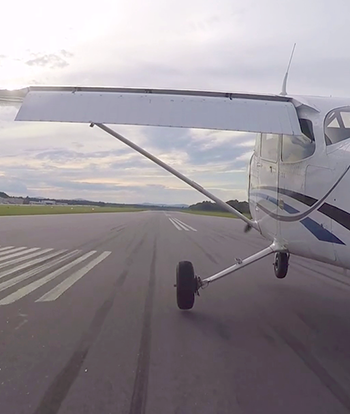 “Pilots often touch down a little sideways when winds are light because they’re not in ‘crosswind landing mode.’ Similarly, variable wind direction is going to be a problem for a pilot who thinks in terms of using ‘left crosswind technique’ or ‘right crosswind technique’.
Often, pilots describe a landing like this:
I have a left crosswind, so I’ll be using right rudder and left aileron, and touching down on the left main wheel first.
To me, that describes the result, not the technique. The proper technique on every landing is to use whatever rudder it takes to align the nose of the airplane with the centerline of the runway, and whatever bank it takes to control drift so the airplane itself stays over the center of the runway. Point the nose with your toes, and use the ailerons to move laterally to stay over the centerline. Use that technique on every landing, and good crosswind landings will follow.
This works when there’s no wind, when winds are strong or variable, and for everything in between. After touchdown, position the ailerons fully into the wind—they should already be deflected that way as a result of the technique—and keep pointing straight down the centerline with the pedals.
A home simulator can be a great tool for practicing this. The controls won’t feel the same, but the concepts are. You can get as many reps as you want in different wind conditions until the relationships between aileron, rudder, drift, and alignment become intuitive.”
When flying a light airplane, when do you transition from crabbing to slipping for alignment down the runway?