Subscriber question:
"Can you explain the difference between loading and activating an approach in a GPS? I know this is a common area of confusion." — Joe M.
Not subscribed yet? Sign up here to receive tips like this every week.
Doug:
 “The first step in removing the veil of confusion is remembering that a GPS primarily navigates TO a fix or waypoint. When we have a flight plan it will sequence from one fix to the next (unless we suspend that sequencing, such as if we must hold).
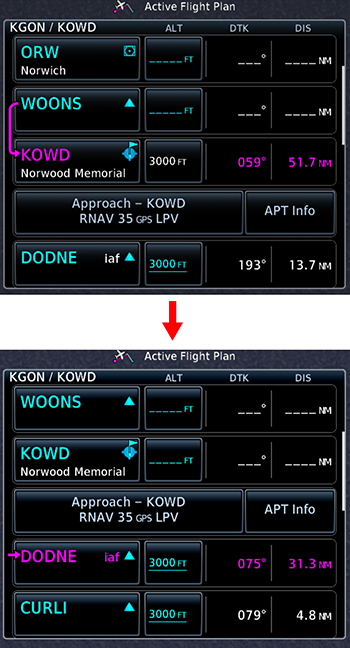
Look at the flight plan for a flight from KGON to KOWD via ORW and WOONS. While we’re in flight and the GPS is taking us from ORW to WOONS, we decide we want the RNAV Rwy 35 approach, starting at DODNE.
Loading the approach will put the approach procedure and its waypoints at the end of the flight plan, after the destination airport—but the GPS will still be navigating us to WOONS and from there to KOWD. This is correct because we haven’t been cleared for the approach. The GPS will sequence from waypoint to waypoint to the destination airport, as cleared. This approach is not active. You can tell that because the magenta arrow to the left of the flight plan waypoints is above the approach procedure title.
When ATC clears us to DODNE, we should activate the approach. We can do this by selecting “Activate approach” or by entering direct-to the initial approach fix. These do exactly the same thing. If ATC clears us to an intermediate fix, we can use direct-to that fix, which will also activate the approach inbound from the IF. If ATC vectors us for the approach, we can activate vectors-to-final or a leg of the approach we expect to intercept.
In all of these cases, the approach is now active—there’s no need to later “activate” the approach. How do you know it’s active? Because the magenta arrow for direct-to or an active leg appears below the approach procedure title.
So to avoid any confusion, don’t activate an approach until ATC clears you to either the initial fix, any fix inside the IAF or for vectors-to-final—and don’t get confused thinking you have to reactivate it if you used a direct-to for getting established on the approach.”
Do you have trouble finding instructors who really understand modern navigators and glass panels?