Subscriber question:
"I'm working toward my private certificate and just can't get this crosswind landing thing. My instructor says I keep touching down crooked, but I don't see it. Help." — Silas T.
Not subscribed yet? Sign up here to receive tips like this every week.
Jeff:
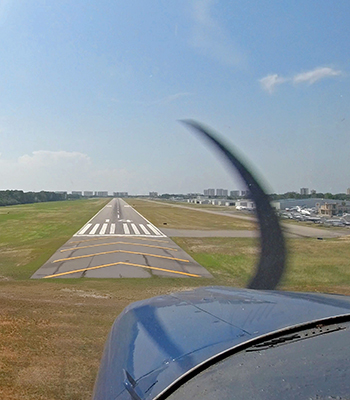 “This skill takes time and practice. The most common error is looking slightly to the pilot’s right. Think about this on the ground. If you were sitting in the left seat and you looked directly over the center of the propeller, you’d be looking slightly to the right of straight ahead. If you tried to align that view with the centerline of the runway, you’d have to turn the whole airplane slightly left—and you’d land crooked if you touched down that way.
The goal is looking straight ahead from the pilot’s seat and down the runway. Some cowlings offer a nice set of rivets out on the end of the nose for alignment. But not all do, and it’s really not the right place to focus during landing.
I find the best way to dial this in is during a low pass with a crosswind and not landing. You and your instructor can find a long, wide runway with a crosswind. The goal is to get within 5 feet or so of the ground and fly in a side slip the full length of the runway. Sometimes it’s best if you focus on the yoke motions for wing-down into the wind and opposite rudder to align the airplane longitudinally with the runway, while the instructor controls the throttle and helps with minor pitch adjustments to keep you flying level.
Here’s the most important part. Let’s assume the crosswind is from the left. Start by aligning on the runway centerline. But then increase the bank angle (and opposite rudder) to move the airplane upwind, so it’s centered on the left side of the runway, halfway between the centerline and the runway edge. Then reduce the bank angle and opposite rudder enough to stabilize there. Then reduce both control inputs more so you drift downwind past the runway centerline. As you get over the right side of the runway, increase again to stabilize. By this point, you’re probably running out of runway, so reestablish a crab angle for the crosswind and climb back into the pattern to come around and try again.
The key skill is correcting your position while keeping the airplane’s fuselage parallel to the runway centerline. That also helps dial in where to look so you know you’re parallel to the centerline.
Unless you live by an old SAC airbase, this probably means going to a bigger airport that might have a tower. That’s fine. Go during a low-traffic time and just explain that you want to make low passes, full-length for training. I’ve never had this denied.
Two other oddball things that can help. One is to do this in the evening and get the runway lights turned up as bright as practical. Tower will often do this for you on request. There’s something about the long line of lights that can help you see the alignment. It’s even better if it’s an airport with runway centerline lights as a third bright row right down the middle. Unfortunately, winds often die down in the evening, so some planning is required.
The other game is finding an airport with crossing runways such that you can fly a figure-eight pattern, low-passing or landing on one runway, with say a left crosswind, and then joining the pattern to land on the crossing runway with a right crosswind, and then back again. The alternation is fun and a great workout. I’ve even gotten that approved at a quiet towered airport.”
What's the hardest thing for you to do consistently well with crosswind landings?