
Subscriber question:
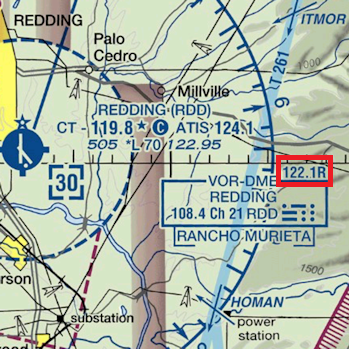
"I still like contacting Flight Service Stations for in-flight weather or flight planning. But I never understood what to do when there's an ‘R’ listed by the frequency. A quick review would be helpful." - Kevin W.
Not subscribed yet? Sign up here to receive tips like this every week.
John:
 “Flight Service Stations (FSS) provide a variety of services including pilot briefings, weather observations, pilot reports, flight plan processing, search and rescue services, assistance to lost aircraft and aircraft in emergencies.
Normally, you would communicate with Flight Service through the frequencies shown on the sectional chart. The Flight Service frequencies are listed in a box above certain VOR stations. The most common frequencies are 122.2, 122.4, or 122.6. Also, most GPS (or iPad apps like ForeFlight) have a listing of the nearest Flight Service frequencies.
At times because of the aircraft altitude or distance from the station, you may not be able to receive and transmit on the same frequency. To increase reception range, some Flight Service Stations are also able to transmit over VORs and other Navaids. The notation R shown after the frequency indicates Receive capability (i.e. 122.1R). This means that the FSS can receive on 122.1 and transmit over the VOR frequency.
You need to configure your aircraft radio and audio panel properly to utilize this feature. First, tune your Com radio to 122.1. Then tune the Nav radio to the VOR you wish to use. Select both the Nav and the Com audio through your audio panel. You may also have to select voice on your Nav radio.
On your initial call to the FSS, make sure you state the frequencies that you are transmitting and receiving on. The FSS specialist may be monitoring multiple frequencies.
For example, you would call Rancho Murieta Radio, Cessna One Two Three Alpha, transmitting 122.1, listening Redding VOR, over.”
Do you use Flight Service in-flight for assistance?