Subscriber question:
"Any tips for flying into a Class C airport? I fly out of a small non-towered airport and find Class C intimidating." - Matthew T.
Not subscribed yet? Sign up here to receive tips like this every week.
John:
 “Class C airspace is nothing to be afraid of. All it takes is some preparation and good communication skills.
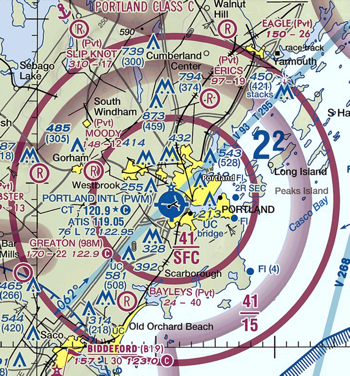
Basically, all Class C airspace is the same. The inner core is a 5NM radius of the primary airport from the surface to 4,000 feet above the primary airport. The outer ring is a 10 NM radius shelf that starts (at least) 1,200 feet above the primary airport.
Before your first flight, review the sectional chart for your destination. The sectional will have a box depicting the approach control frequency in the sector from which you are approaching. It’s a good idea to review the airport diagram as well. You can usually determine the active runway based on the wind forecast. You should have an idea where you will turn off the runway after landing and the most probable taxi route to your destination on the airport.
Prior to initial call-up, listen to the ATIS and pay particular attention to any NOTAMS or remarks such as taxiway closures. Contact approach control using the standard three W’s – who you are, where you are and what you want. Approach control will issue a transponder code and instructions or vectors for entering the traffic pattern. At some point, around five miles from the airport, approach will tell you to contact the tower. After that, it is just like any other towered airport. Simply follow the tower’s instructions until you land, clear the runway and taxi to your destination.
When departing, reverse the process by contacting clearance delivery. They will issue a transponder code, departure frequency and sometimes an altitude to maintain until advised.”