
Subscriber question:
"When are you supposed to leave minimums during a circling approach?" - Benigno V.
Not subscribed yet? Sign up here to receive tips like this every week.
Bob:
“Chapter 10 of The FAA’s Instrument Flying Handbook (FAA-H-8083-15A) gives us very specific guidance:
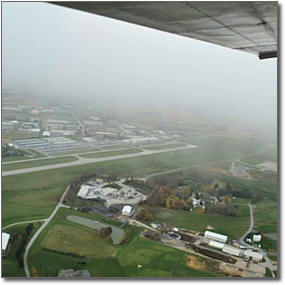 The circling minimums published on the instrument approach chart provide a minimum of 300 feet of obstacle clearance in the circling area. During a circling approach, the pilot should maintain visual contact with the runway of intended landing and fly no lower than the circling minimums until positioned to make a final descent for a landing.
It is important to remember that circling minimums are only minimums. If the ceiling allows it, fly at an altitude that more nearly approximates VFR traffic pattern altitude. This will make any maneuvering safer and bring the view of the landing runway into a more normal perspective.
Pilots may not operate an aircraft at any airport below the authorized MDA or continue an approach below the authorized DA/DH unless:
1. The aircraft is continuously in a position from which a descent to a landing on the intended runway can be made at a normal descent rate using normal maneuvers;
2. The flight visibility is not less than that prescribed for the approach procedure being used; and
3. At least one of the following visual references for the intended runway is visible and identifiable to the pilot:
a) Approach lighting system
b) Threshold
c) Threshold markings
d) Threshold lights
e) Runway end identifier lights (REIL)
f) Visual approach slope indicator (VASI)
g) Touchdown zone or touchdown zone markings
h) Touchdown zone lights
i) Runway or runway markings
j) Runway lights
Always remember that we are only given 300 feet of obstacle clearance on a circling approach. Cheating is deadly!”